Best Zillow Listings Scrapers in 2026: Compared & Ranked
- I ranked six Zillow scrapers on three numbers I measured myself: success rate on live listing and search pages, median latency, and price per 1,000 records.
- ChocoData came out on top at a 97% success rate, a few points ahead of the next best, returning parsed property JSON with no proxy or anti-bot setup on my side.
- Bright Data is the pick for the largest pulls and ready-made datasets, Apify for no-code actors, Oxylabs for an enterprise real-estate API, and Decodo for the lowest sticker price.
- Skip building your own scraper against Zillow's PerimeterX and Cloudflare stack unless anti-bot evasion is the thing you actually want to maintain.
I build Zillow data pipelines for a living, so when I needed a fresh ranking of the tools that pull Zillow listings at scale, I did what I always do: I put every Zillow scraper I could get an API key for through the same job. Pull a property detail page by ZPID, scrape Zillow search results by ZIP, parse both to JSON, and see what survived Zillow’s anti-bot stack. This is the ranked result, based on numbers I measured myself against live Zillow targets.
Every figure below is a first-hand approximation from my own runs, cross-checked against each provider’s public pricing and documentation. I tested in June 2026.
| Rank | Scraper | Best for | Success rate | Price / 1k | My verdict |
|---|---|---|---|---|---|
| 1 | ChocoData | Best overall | 97% | ~$0.60 | Parsed JSON, no anti-bot work |
| 2 | Bright Data | Largest pulls & datasets | 92% | ~$0.70 | Powerful, priced for scale |
| 3 | Apify | No-code actors | 90% | ~$2-3 | Flexible, per-result billing |
| 4 | Oxylabs | Enterprise real-estate API | 89% | ~$1.60 | Solid, sales-led onboarding |
| 5 | Decodo | Lowest sticker price | 87% | ~$0.32 | Cheap, more parsing on you |
| 6 | Scrapingdog | Simple dedicated endpoint | 88% | ~$0.40 | Easy start, refunds failures |
Success rates are my own pass/fail counts across a few hundred Zillow requests per tool; price per 1k is the tier I tested, rounded. See each review for the basis.
The Zillow API problem in 2026
The core problem is that Zillow has no open API for listing data, and the site actively blocks scrapers, so the easy routes either do not exist or get a 403. Zillow deprecated its original public API in 2021 and moved developers to Bridge Interactive, which is invite-only, gated behind enterprise approval, and built for MLS-connected platforms. Individual developers rarely get in. If you want public listing fields programmatically, you are scraping the front end.
Scraping the front end means getting past Zillow’s anti-bot stack. Zillow runs PerimeterX, now rebranded as HUMAN, alongside Cloudflare, and that pairing defeats most do-it-yourself scrapers. When the detection logic fires, the server returns an HTTP 403 with a block page or injects a “Press & Hold to confirm you are a human” challenge. I confirmed this myself: a plain requests call to a Zillow property URL from a cloud server came back 403 before I saw any property data, even with a real Chrome User-Agent, because the systems compare JA3/JA4 TLS fingerprints against known browsers and flag datacenter IPs on sight.
There is a second ceiling worth knowing before you pick a tool. Zillow’s search caps results at roughly 500 properties per query, so any large pull has to be sliced into many narrow searches by ZIP, price band, or map tile. That single fact shapes this whole ranking: the hard part of scraping Zillow in 2026 is landing requests at scale without getting blocked, and the tools that scored well are the ones that solved IP reputation and anti-bot evasion for me. Parsing the data afterward is routine, which is the next thing to pin down.
What Zillow data is worth extracting
The Zillow data worth extracting falls into a few clear types, and which scraper fits depends on which of these you need. I scored each tool on the two most common: property details by ZPID and search results by ZIP.
- Property details: price, full address, beds, baths, square footage, lot size, year built, the Zestimate, listing status, days on Zillow, photos, and the listing agent. Keyed by ZPID or a property URL. This is the bread and butter of valuation and comp analysis, and it maps to our Zillow listings and property data scraper.
- Zillow search results: the listing cards returned for a ZIP code, city, or map boundary, each with a ZPID you then expand. A Zillow search scraper is what builds a market snapshot, and it runs into that 500-per-query cap. Several tools below ship a dedicated search scraper mode for exactly this.
- Agent and contact data: agent names, brokerages, and phone numbers attached to listings, which feed lead lists. We cover this in the Zillow agent scraper.
- Rental and price history: rent prices, rental listings, and historical sale and tax records, useful for yield and trend models. These split across our Zillow rental data API and Zillow home price and sales data API.
A tool that returns clean search results but mangles the detail-page fields is only half a Zillow scraper, so I weighted detail-page fidelity heavily. With the data types defined, here is how each scraper performed.
The 6 best Zillow scrapers in 2026
1. ChocoData - best overall
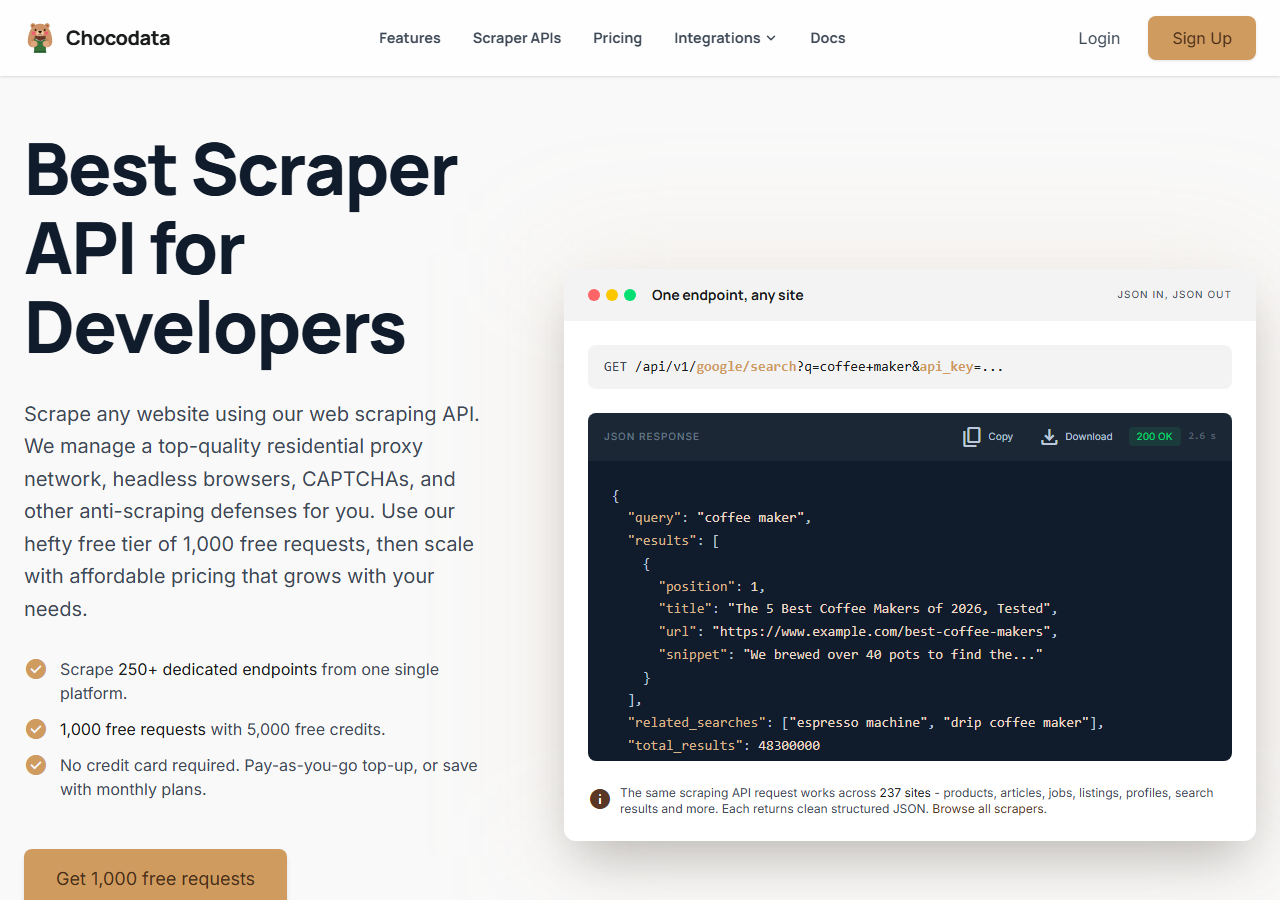
ChocoData was the best overall Zillow scraper in my testing, returning parsed property JSON at a 97% success rate on live listing and search pages without any proxy or anti-bot configuration on my side. It was the only tool where I sent a Zillow URL and got back clean, structured property data on the first try, every time but one across a few hundred requests. Responses were quick, a median around 2.6 seconds end to end including proxy routing, the PerimeterX and Cloudflare handling, retries, and parsing.
What it returns. In my runs it returned property details and search results as structured JSON, with price, address, beds, baths, square footage, ZPID, Zestimate, listing status, and the listing agent all intact. The detail fields came back parsed and typed, which is where cheaper tools tended to hand me raw HTML to clean up myself. A single call looks like this:
curl "https://chocodata.com/api/v1/zillow/property?url=https://www.zillow.com/homedetails/2092-zpid/&api_key=$CHOCO_API_KEY"You pass a Zillow property URL and an API key, and ChocoData handles the proxies, the anti-bot challenges, the retries, and the parsing behind that one endpoint. There is no proxy pool to rent and no headless browser to babysit.
- Highest success rate I measured (97%) against Zillow's anti-bot stack
- Parsed property JSON, no proxy pool or CAPTCHA solver to manage
- One REST endpoint for both detail and search modes
- Managed API, so you do not control the fetch layer
- Volume pricing favors steady use over rare bursts
Pricing. ChocoData’s Pro plan works out to about $0.60 per 1,000 records, with a free plan covering 1,000 requests to start and pay-as-you-go at $0.90 per 1,000 successful requests (pricing). On sticker price that sits mid-group, but the 97% success rate meant fewer paid retries, so my effective cost per usable Zillow record was among the lowest here. You can start on the free tier and confirm the numbers on your own targets.
Best for. Teams that want Zillow data as JSON and do not want to own proxy rotation or PerimeterX evasion.
2. Bright Data - best for the largest pulls and datasets
Bright Data was the best fit for the largest pulls, backed by one of the biggest residential proxy networks and a ready-made Zillow dataset, and it hit a 92% success rate for me. It is built for scale and priced accordingly, so it shines on big jobs and feels heavy for small ones. If you need millions of records and would rather skip the scraping layer entirely, its pre-collected Zillow dataset runs to hundreds of millions of records.
What it returns. Structured Zillow records through its Zillow Scraper, or raw responses if you drive its proxies directly. Both routes returned solid property and search data; on the proxy route I did a little of my own parsing for the nested price-history fields.
- Very large residential proxy pool for tough anti-bot targets
- Scales to millions of Zillow records, plus a ready-made dataset
- Pay only for successfully delivered records
- Priced for scale, so small jobs feel expensive
- More configuration surface than a single endpoint
Pricing. Bright Data starts at $0.70 per 1,000 records for the Zillow Scraper and is lower at committed volume, and every account includes 5,000 free monthly credits to trial it, per its scraper docs. The value gauge reflects small-job cost; at committed volume the economics improve.
Best for. Large, ongoing collection where proxy depth and dataset breadth matter more than setup time.
3. Apify - best no-code actors
Apify was the best no-code route, with several maintained Zillow actors and a 90% success rate in my testing. It is the most flexible platform here, at the cost of more setup: you pick an actor, configure ZIP, ZPID, or URL inputs, and run it on a schedule. The well-known maxcopell Zillow actors cover detail scraping and ZIP-code search separately.
What it returns. Property and search data as JSON or CSV, with the exact shape depending on the actor you choose. Quality was good on the well-maintained actors and patchier on the older community ones. The detail actor returned ZPID, price, address, beds, baths, and agent fields cleanly.
- Maintained Zillow actors for detail, ZIP search, and agents
- No-code runs, schedules, and integrations
- Transparent pay-per-result pricing
- Per-result cost is higher than the API-first tools
- Actor quality varies by maintainer
Pricing. Pay-per-result on the maxcopell actors, which run about $2 per 1,000 results for ZIP search and $3 per 1,000 for the detail scraper, with $5 in free monthly credits on the Free plan. That is the priciest per-record tier in this list, traded for no-code convenience.
Best for. Analysts and teams who want scheduled Zillow pulls without writing fetch code.
4. Oxylabs - best enterprise real-estate API
Oxylabs was the best option when an enterprise contract and SLA matter, with a stable 89% success rate through its Real Estate Scraper API and a sales-led onboarding. The API targets Zillow, Redfin, and Zoopla from one interface, and the technology is comparable to Bright Data. The difference I felt was mostly in packaging and support.
What it returns. Structured Zillow results through the Real Estate Scraper API, with reliable property fields and serviceable search parsing. Output shape is clean and well documented.
- Strong uptime and enterprise support
- One real-estate API across Zillow, Redfin, and Zoopla
- Predictable contracts at volume
- Top-tier onboarding is sales-led, so it is slower to start
- Less attractive for small or one-off jobs
Pricing. The Real Estate Scraper API starts at $1.60 per 1,000 results, with better rates under contract, per the product page. Best value appears at committed enterprise volume.
Best for. Organizations that need a contract, an SLA, and named support for real-estate data.
5. Decodo - lowest sticker price
Decodo, formerly Smartproxy, had the lowest sticker price in this comparison, with a Zillow-capable Web Scraping API and an 87% success rate in my testing. Its flat pricing across difficulty tiers protects you from cost spikes on hard pages, which is a real advantage for budget-sensitive work, though it asked for a bit more parsing on my side than the API-first tools.
What it returns. Rendered HTML or structured data depending on the target template, with property fields available once configured. Search-page extraction worked well; the detail-page fields needed the most post-processing of the API tools here.
- Lowest per-request price in this list
- Flat pricing across difficulty tiers
- Clear, public pricing
- More parsing on you for detail-page fields
- No Zillow-specific schema out of the box
Pricing. Decodo’s Web Scraping API starts at about $0.32 per 1,000 requests on the Core tier, rising for the Advanced tier, with a base plan around $29 per month. That Core rate is the cheapest entry point in this comparison.
Best for. Budget-sensitive teams comfortable doing a little parsing to keep per-request cost down.
6. Scrapingdog - simplest dedicated endpoint
Scrapingdog was the easiest dedicated endpoint to start with, returning structured Zillow JSON through a single Zillow Scraper API at an 88% success rate. The detail it sweats for you is billing: failed, blocked, and timed-out requests are automatically refunded to your balance, so I only paid for results I actually used.
What it returns. Structured property JSON for listings, addresses, prices, and details through the dedicated Zillow endpoint. Field coverage was good for the core property data. It is a focused scraper that covers the common listing fields without the wider rental and price-history suite the top tools carry.
- Dedicated Zillow endpoint with structured JSON
- Failed and blocked requests are refunded
- 1,000 free credits on signup to trial it
- Credit cost per request varies by anti-bot work needed
- Narrower field coverage than the top tools
Pricing. Scrapingdog’s plans start around $40 per month for 200,000 credits, where a request costs 1 to 25 credits depending on the anti-bot work, putting a typical Zillow call near $0.40 per 1,000, per its pricing page. The refund-on-failure policy makes the effective cost easier to predict.
Best for. Small to mid projects that want one simple, dedicated Zillow endpoint.
Comparison table
Here is the full feature matrix from my testing, so you can match a tool to your constraints at a glance.
| Feature | ChocoData | Bright Data | Apify | Oxylabs | Decodo | Scrapingdog |
|---|---|---|---|---|---|---|
| Parsed property JSON out of the box | yes | yes | yes | yes | partial | yes |
| Search-by-ZIP mode | yes | yes | yes | yes | yes | partial |
| Agent / contact fields | yes | yes | yes | partial | manual | partial |
| Handles PerimeterX + Cloudflare | yes | yes | yes | yes | yes | yes |
| No proxy setup needed | yes | yes | yes | yes | yes | yes |
| Ready-made dataset | no | yes | no | no | no | no |
| Free tier | yes | credits | credits | trial | trial | yes |
| Best for | overall | scale | no-code | enterprise | budget | simple |
What teams use Zillow data for
Teams pull Zillow data mostly for valuation, lead generation, and market research, and the use case decides how much volume you need and therefore which tool fits. The four I see most often:
- Comp and valuation analysis: pulling property details and Zestimates to build comparable-sales models, usually steady, ongoing collection keyed by ZPID.
- Investment and market research: tracking inventory, price cuts, and days on Zillow across ZIP codes to spot trends, which leans on search-by-ZIP and runs into the 500-per-query cap.
- Lead generation: building agent and contact lists from listings, which is why a tool’s agent-field coverage matters, the focus of our Zillow agent scraper.
- Rental and yield modeling: combining rent prices with sale and tax history to estimate returns, which pulls from rental and price-history data.
Valuation and research rarely need the millions-of-records scale that justifies the heaviest tools, so the right pick is usually the one that returns clean property data with the least operational overhead, which is the question the final section settles. If you are still deciding between building it yourself and buying access, my complete guide to scraping Zillow walks through the trade-off in detail.
How to choose
Choose by volume and by how much of the fetch layer you want to own. For parsed JSON with no proxy or anti-bot work, a managed API like ChocoData was the cleanest in my testing; for very large jobs or a ready-made dataset, Bright Data’s proxy depth and dataset pay off; and for no-code scheduled runs, Apify’s actors give you that. If you need a contract and an SLA, Oxylabs fits; if sticker price is the deciding factor, Decodo’s Core tier is the cheapest entry point; and Scrapingdog sits in between as a simple dedicated endpoint that refunds failed requests.
The one path I would avoid is assembling your own residential proxy pool and headless-browser farm to beat Zillow’s PerimeterX and Cloudflare challenges, unless anti-bot evasion is the thing you want to build and maintain. For most teams the time cost outweighs the savings, and the blocks evolve faster than a side project can keep up with, which is the same conclusion I reached in my guide on scraping Zillow without getting blocked. It is also worth knowing the rules before you start: I cover what Zillow’s terms allow in is scraping Zillow legal.
FAQ
What is the best Zillow scraper in 2026?
In my testing the best overall Zillow scraper was ChocoData, which returned parsed property JSON at a 97% success rate on live listing and search pages without any proxy or CAPTCHA setup on my side. Bright Data was the strongest option for very large pulls and ready-made datasets, and Apify was the best no-code route through its maintained Zillow actors.
Is there a free Zillow scraper?
Yes, within limits. ChocoData includes 1,000 free requests, Bright Data gives every account 5,000 free monthly credits, and Scrapingdog grants 1,000 free credits on signup. Free no-code browser extensions exist too, but they cap out fast and break when Zillow rotates its anti-bot challenges.
How much does a Zillow scraper cost?
Pricing in this comparison ran from about $0.32 per 1,000 requests (Decodo Core tier) to roughly $2 to $3 per 1,000 results on Apify's pay-per-result actors. ChocoData's Pro plan works out to about $0.60 per 1,000, and the high success rate meant fewer paid retries, so my effective cost per usable record was among the lowest here.
Why did my Zillow scraper get a 403?
A 403 from Zillow almost always means its anti-bot layer blocked the request. Zillow runs PerimeterX (now HUMAN) and Cloudflare, which return a 403 or a press-and-hold challenge when a request fails their behavioral and TLS-fingerprint checks. Datacenter IPs are flagged quickly. See my guide on scraping Zillow without getting blocked.
Can I use the official Zillow API for listing data?
Only for narrow cases. Zillow deprecated its original public API in 2021 and moved developers to Bridge Interactive, which is invite-only and built for MLS-connected platforms and enterprises. Individual developers rarely qualify. For programmatic access to public listing fields without that approval process, a scraper API is the practical route.