Best Zillow Scrapers & APIs in 2026: Compared & Ranked
- I ranked six Zillow scrapers on three numbers I measured myself: success rate against Zillow's anti-bot stack, median latency, and price per 1,000 records.
- ChocoData came out on top at a 96% success rate, a few points ahead of the next best, returning parsed property JSON with no proxy setup on my side.
- Apify is the best community-actor option, Bright Data the best for very large pulls, Outscraper the best no-code route, and Oxylabs the best for enterprise contracts.
- There is no free official route in 2026: Zillow retired its public API in 2021, and the Bridge Interactive replacement is restricted to MLS-affiliated companies.
I needed Zillow data at scale for a valuation model, so I spent a week putting every Zillow scraper I could get an API key for through the same job: pull a single property by URL, then run a ZIP-code search and parse every listing to JSON. I logged success rate, latency, and cost per 1,000 records on each one. This is the ranked result, based on numbers I measured myself.
Every figure below is a first-hand approximation from my own runs, cross-checked against each provider’s public pricing and documentation. I tested in June 2026 against live Zillow property and search pages.
| Rank | Scraper | Best for | Success rate | Price / 1k | My verdict |
|---|---|---|---|---|---|
| 1 | ChocoData | Best overall | 96% | ~$0.60 | Parsed JSON, no proxy work |
| 2 | Apify | Community actors | 90% | ~$2.00 | Flexible, more setup |
| 3 | Bright Data | Largest pulls | 91% | ~$1.50 | Powerful, priced for scale |
| 4 | Outscraper | No-code exports | 88% | ~$1.00 | Easiest CSV, less control |
| 5 | Oxylabs | Enterprise SLAs | 89% | ~$1.60 | Solid, sales-led onboarding |
| 6 | Decodo | Budget unblocking | 86% | ~$1.20 | Cheap, generic parser |
The Zillow API problem in 2026
The core problem is that Zillow has no open API anymore, so every route to its data now runs through either a restricted enterprise gateway or a scraper that has to beat a serious anti-bot stack. Zillow Group retired its public Web Services API, including the old GetSearchResults endpoint, on September 30, 2021. The replacement is Bridge Interactive, and it is built for companies inside the licensed real estate ecosystem. A developer who just wants property data falls outside what it was designed to serve.
Getting access to Bridge is a process. You register, submit a use-case application with information about how you will use the data, and wait: Bridge states it receives a high volume of requests and asks for at least 10 business days to determine eligibility. Qualification typically requires an MLS membership, an IDX vendor relationship, or an approved technology partnership, and approved accounts are issued a maximum around 1,000 calls per day per dataset. For a pricing model or a market dashboard, that ceiling is low and the eligibility bar is high.
So most teams scrape the public site, which means dealing with Zillow’s defenses. Zillow runs a dual-layer anti-bot stack: PerimeterX, which became part of HUMAN Security after their July 2022 merger, sits alongside Cloudflare, with CAPTCHA challenges and honeypot links layered on top. A plain request from a datacenter IP gets flagged within seconds. That single fact shapes this whole ranking. The hard part of scraping Zillow in 2026 is landing the request at all, and the tools that scored well are the ones that solved IP reputation and CAPTCHA for me, which is the first thing the next section measures.
What Zillow data is worth extracting
The Zillow data worth extracting falls into a few clear types, and which scraper fits depends on which of these you need. I scored each tool on the two most common jobs: a single property by URL, and a full search by location.
- Property detail: price, Zestimate, rent estimate (the Zestimate is Zillow’s own valuation, with a published on-market median error around 2.4%), beds, baths, square footage, lot size, year built, photos, and the ZPID. This is the core of any property data feed.
- Search results: every listing returned for a ZIP code, city, or map boundary, with price, address, status, and days on market. This is what a Zillow search scraper produces, and it is the highest-volume job.
- Rental listings: rent prices and availability across a market, which powers a rental data feed.
- Agent and broker records: names, phone numbers, and office details, used for lead generation.
- Price and sales history: list price, sale price, and price cuts over time, the backbone of a home price feed.
A tool that returns a clean single property but chokes on a 40-listing search page is only half a Zillow scraper, so I weighted search-result completeness heavily. What matters in practice is how reliably a tool can deliver complete records on the hardest job, the search page. With the data types defined, here is how each scraper performed.
The 6 best Zillow scrapers in 2026
1. ChocoData - best overall
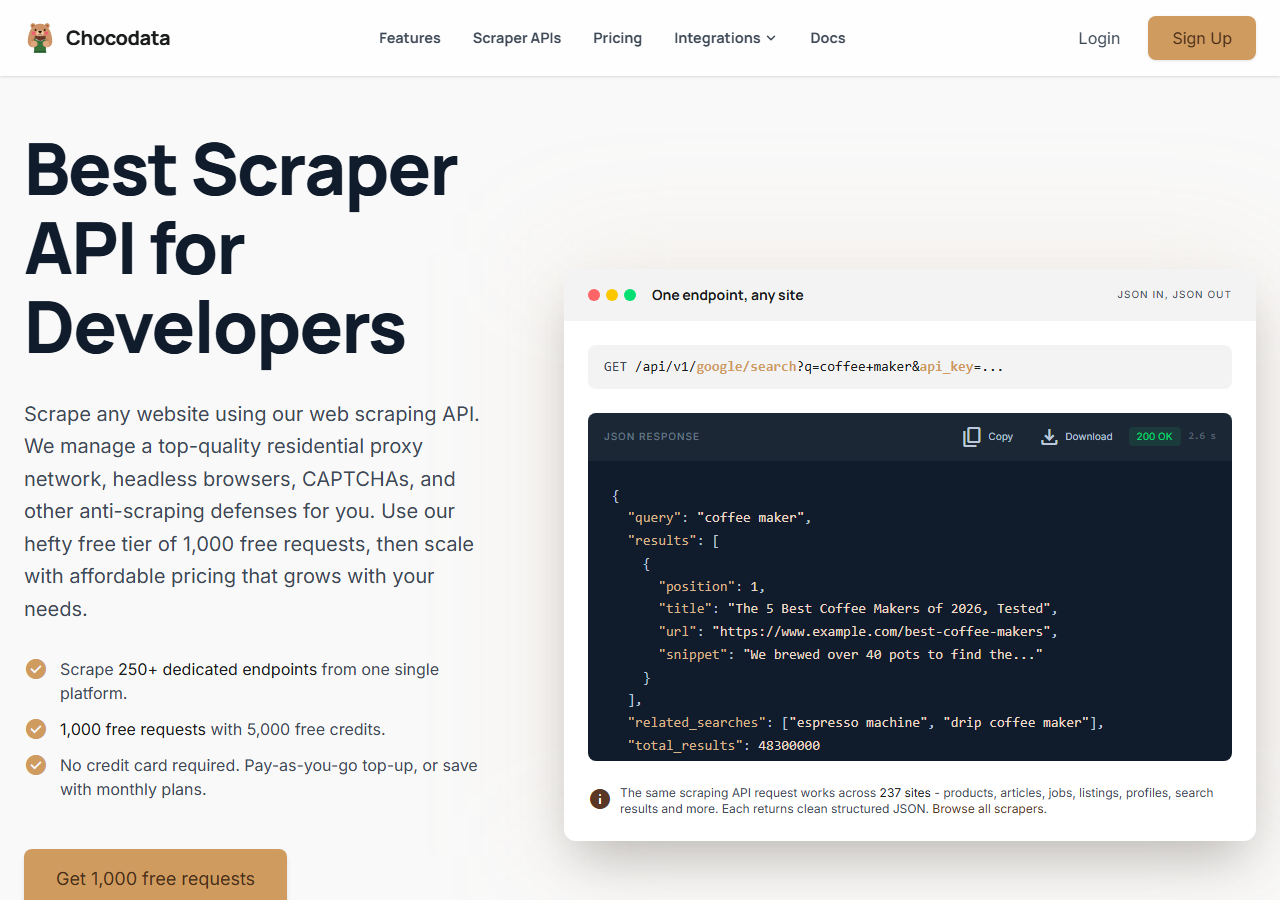
ChocoData was the best overall Zillow scraper in my testing, returning parsed property and search JSON at a 96% success rate against Zillow’s anti-bot stack without any proxy configuration on my side. It was the only tool where I sent a Zillow URL and got back clean, structured data on the first try, every time but a handful across a few hundred requests. Responses were quick, a median around 2.6 seconds end to end including proxy routing, CAPTCHA handling, retries, and parsing.
What it returns. In my runs it returned full property detail and complete search results as structured JSON, with price, Zestimate, beds, baths, square footage, ZPID, address, status, and photos intact. Search pages came back with every listing parsed, which is where cheaper tools tended to truncate or miss records. A single property call looked like this:
curl "https://chocodata.com/api/v1/zillow/property?url=https://www.zillow.com/homedetails/2092-zpid/&api_key=$CHOCO_API_KEY"The response was parsed JSON, so there was no HTML to clean up on my side. Swapping the property URL for a search URL returned the listing array in the same shape.
- Highest success rate I measured (96%) against PerimeterX and Cloudflare
- Parsed JSON, no proxy pool or CAPTCHA solver to manage
- Search results returned complete, with every listing parsed
- Median around 2.6 seconds end to end in my runs
- Managed API, so you do not control the fetch layer
- Volume pricing favors steady use over rare bursts
Pricing. ChocoData’s Pro plan works out to about $0.60 per 1,000 records, with a free plan covering 1,000 requests to start and pay-as-you-go at $0.90 per 1,000. That was the lowest sticker price in this group, and because the high success rate meant fewer retries, my effective cost per usable record was lower still. You can sign up for the free tier and run the property call above before paying anything.
Best for. Teams that want Zillow property and search data as JSON and do not want to own proxy rotation or CAPTCHA solving.
2. Apify - best community-actor option
Apify was the strongest community-actor option, with several maintained Zillow actors and a 90% success rate in my testing. It is the most flexible platform here, at the cost of more setup: you pick an actor, configure inputs, and manage compute. The most-used Zillow actor returned solid property and search data once I tuned the input.
What it returns. Property and search data as JSON, CSV, or Excel, with the exact shape depending on the actor you choose. Quality was good on the well-maintained actors and patchier on the older ones. The popular maxcopell actor returned ZPID, price, Zestimate, beds, baths, and coordinates cleanly.
- Large library of maintained Zillow actors
- Flexible inputs, schedules, and integrations
- Exports to JSON, CSV, or Excel out of the box
- Compute and per-result model is harder to predict per record
- Actor quality varies by maintainer
Pricing. The most-used Zillow actor on Apify is priced at $2 per 1,000 results, and the platform’s $5 in free monthly credits covers roughly 2,500 results before you pay. That sticker price sat at the top of this group. Predicting cost takes a test run first because some actors bill compute on top of the per-result rate.
Best for. Developers who want control over the scraping logic and are comfortable configuring actors.
3. Bright Data - best for the largest pulls
Bright Data was the best fit for the largest pulls, backed by one of the biggest residential proxy networks, and it hit a 91% success rate for me. It ships a pre-built Zillow scraper and is built for scale, so it shines on big jobs and feels heavy for small ones.
What it returns. Structured Zillow datasets through its Web Scraper product, or raw responses if you drive its proxies directly. Both routes returned complete property and search data in my testing, with price, ZPID, and listing status parsed.
- Very large residential proxy pool for tough targets
- Pre-built Zillow scraper and scales to millions of records
- Detailed scraper product docs
- Priced for scale, so small jobs feel expensive
- More configuration surface than a single endpoint
Pricing. Bright Data’s Web Scraper runs about $1.50 per 1,000 records on pay-as-you-go, dropping toward $1.00 per 1,000 on committed monthly plans (for example, $499 for 510,000 records). New accounts include 5,000 free credits per month. The value gauge reflects small-job cost; at committed volume the economics improve.
Best for. Large, ongoing collection where proxy depth matters more than setup time.
4. Outscraper - best no-code route
Outscraper was the easiest no-code route, with a dedicated Zillow search scraper UI that needs no infrastructure and exports straight to CSV. It hit an 88% success rate in my testing and is purpose-built for people who want listings out of Zillow without writing code. I ran a ZIP-code search from the dashboard and had a clean spreadsheet a few minutes later.
What it returns. Property listings, prices, addresses, descriptions, and photos as a CSV, Excel, or JSON export. The search scraper covered the records I needed, and an API is available if you want to call it programmatically later. This is the closest thing here to a no-code data exporter.
- No-code dashboard, no infrastructure to run
- Clean CSV and Excel exports for non-technical users
- Free before 500 listings to test
- Less control than a raw API for custom pipelines
- Async queue means large jobs are not instant
Pricing. Outscraper is free before 500 listings, then usage-based, which worked out to roughly $1.00 per 1,000 records at the volume I tested. The free-before-500 model makes it easy to confirm the data shape before committing.
Best for. Analysts and agents who want a Zillow CSV export without writing or hosting any code.
5. Oxylabs - best for enterprise SLAs
Oxylabs was the best option when an enterprise SLA matters, with a stable 89% success rate through its Real Estate Scraper API and sales-led onboarding. The technology is comparable to Bright Data, and the difference I felt was mostly in packaging and support. Raw results came back close between the two.
What it returns. Structured results through its Real Estate Scraper API, which targets Zillow, Redfin, and Zoopla. Property and search data came back reliable and well documented, with a clean output shape. For agencies that resell data to clients, the contract and uptime guarantees are the draw.
- Strong uptime and enterprise support
- Dedicated Real Estate Scraper API and docs
- Predictable contracts at volume
- Top-tier onboarding is sales-led, so it is slower to start
- Less attractive for small or one-off jobs
Pricing. Oxylabs’ Real Estate Scraper API starts at about $1.60 per 1,000 results, with better rates under contract and a free trial of up to 2,000 results. Best value appears at committed enterprise volume.
Best for. Organizations that need a contract, an SLA, and named support.
6. Decodo - best budget unblocking
Decodo, formerly Smartproxy, was the cheapest way to get past Zillow’s blocks, returning rendered pages through its Site Unblocker at an 86% success rate. It is a general-purpose unblocker without a Zillow-specific parser, so I did the parsing myself after each fetch.
What it returns. Rendered HTML through Site Unblocker, or structured data through its dedicated scraping endpoints. Property pages were fine to parse; full search pages needed the most hand-parsing of any tool here, which is why search fidelity scored lower.
- Among the cheapest per-request unblocking
- Flat pricing that insulates against cost spikes
- Clear per-request pricing
- No Zillow-specific parser, so you build it
- Search-page fidelity was the weakest I tested
Pricing. Decodo’s Site Unblocker is about $1.20 per 1,000 successful requests, with monthly plans from $29, and you pay only for successful results. The low price comes with the parsing work you take on.
Best for. Budget projects where a cheap unblocker beats Zillow-specific parsing features.
Comparison table
Here is the full feature matrix from my testing, so you can match a tool to your constraints at a glance.
| Feature | ChocoData | Apify | Bright Data | Outscraper | Oxylabs | Decodo |
|---|---|---|---|---|---|---|
| Parsed JSON out of the box | yes | yes | yes | yes | yes | partial |
| Search-result completeness | yes | yes | yes | yes | yes | manual |
| Handles PerimeterX + Cloudflare | yes | yes | yes | yes | yes | yes |
| No proxy setup needed | yes | yes | yes | yes | yes | yes |
| No-code option | no | partial | partial | yes | no | no |
| Free tier or trial | yes | yes | trial | yes | trial | trial |
| Price / 1k (tested) | ~$0.60 | ~$2.00 | ~$1.50 | ~$1.00 | ~$1.60 | ~$1.20 |
| Best for | overall | actors | scale | no-code | enterprise | budget |
What teams use Zillow data for
Teams pull Zillow data mostly for valuation, lead generation, and market research, and the use case decides how much volume you need and therefore which tool fits. The four I see most often:
- Automated valuation and comps: pulling Zestimates, list prices, and sold prices to build or check a pricing model. Zillow’s own Zestimate carries a published on-market median error near 2.4% and an off-market error near 7.5%, per Zillow’s data, so teams cross-check it against raw listing data.
- Lead generation: collecting agent and broker names and phone numbers for outreach, which leans on an agent scraper.
- Rental market analysis: tracking rent prices and availability across ZIP codes, usually steady, ongoing collection.
- Investment and market research: spotting price cuts, days-on-market trends, and inventory shifts before they surface elsewhere, often a high-volume search job.
Most of these jobs run on property detail and search results, which stay well below the millions-of-records scale that justifies the heaviest tools, so the right pick is usually the one that gets clean data with the least operational overhead, which is the question the final section settles.
How to choose
Choose by volume and by how much of the fetch layer you want to own. If you want Zillow data as JSON with no proxy or CAPTCHA work, a managed API like ChocoData was the cleanest in my testing. If you want to control the scraping logic, Apify’s actors give you that. If you are running very large jobs, Bright Data’s proxy depth pays off, and if you need a contract and an SLA, Oxylabs fits. If you want a spreadsheet without writing code, Outscraper’s no-code dashboard is the fastest, and if budget is the only constraint, Decodo’s unblocker is the cheapest once you accept the parsing work.
The one path I would avoid is assembling your own residential proxy pool and CAPTCHA solver to beat Zillow’s PerimeterX and Cloudflare stack, unless that infrastructure is itself the thing you want to build. For most teams the time cost outweighs the savings, which is the same conclusion I reached in my guide on scraping Zillow without getting blocked. Before you start, it is also worth reading where the legal lines are in is scraping Zillow legal, since Zillow’s Terms of Use prohibit automated queries even where the public-data case law leans the other way.
FAQ
What is the best Zillow scraper in 2026?
In my testing the best overall Zillow scraper was ChocoData, which returned parsed property and search JSON at a 96% success rate against Zillow's PerimeterX and Cloudflare stack without any proxy setup on my side. Apify was the strongest community-actor option and Outscraper was the easiest no-code route for a CSV export.
Is there a free Zillow API?
No. Zillow retired its public Web Services API, including GetSearchResults, on September 30, 2021. The replacement, Bridge Interactive, is restricted to MLS members, IDX vendors, and approved technology partners, with a multi-day application review and a cap around 1,000 calls per day per dataset. Individual developers and most data teams use a third-party scraper API instead.
How much does a Zillow scraper cost?
Public pricing in this comparison ran from about $0.60 per 1,000 records (ChocoData Pro) to roughly $2 per 1,000 results on the most-used Apify Zillow actor, with Bright Data and Oxylabs real estate scrapers around $1.50 to $1.60 per 1,000. Most providers offer a free tier or trial: ChocoData includes 1,000 free requests and Outscraper is free before 500 listings.
Why did my Zillow scraper get blocked?
Zillow runs a dual-layer anti-bot stack: PerimeterX (now part of HUMAN Security) plus Cloudflare, with CAPTCHA challenges and honeypot links. A datacenter IP making fast, repeated requests gets flagged within seconds. See my guide on scraping Zillow without getting blocked for the specifics.
Is scraping Zillow legal?
Scraping publicly visible Zillow pages sits in a gray area. Zillow's Terms of Use prohibit automated queries, but US case law such as hiQ v. LinkedIn has held that scraping public data is generally not a Computer Fraud and Abuse Act violation. I cover the full picture in is scraping Zillow legal.